5 Best 18ft & Giant Trampolines of 2026: Top Rated Reviews
We analyzed the biggest and baddest 18ft trampolines on the market, evaluating frame thickness, spring bounce, and safety enclosures. Whether you need a rectangular gymnastic trampoline for training or a massive round bouncer for neighborhood parties, here are the safest giants for 2026.
Key Takeaways: The 30-Second Summary
- Best Overall (Rectangular): The Happy Trampoline Galactic Xtreme is the ultimate gymnastic choice. Its heavy-duty frame and massive bounce surface make it the gold standard for serious tumblers.
- Best Value (Round): The Zupapa 16FT Round offers immense jumping space (16ft is the largest standard round size) and a 425lb weight capacity, perfect for recreational family fun.
- Best for Safety: The Skywalker Rectangle features their patented no-gap enclosure, eliminating the risk of pinched toes. It’s a close competitor in size to a full 18-footer.
- Bounce Physics: Rectangular trampolines (like the Galactic Xtreme) give an even bounce everywhere, while round ones pull you to the center. Choose rectangle for gymnastics, round for safety.
- Buying Tip: Wind anchors are mandatory for 18ft trampolines. Their massive surface area acts like a sail.

Galactic Xtreme
Best Overall (Rectangular)
The closest thing to an Olympic trampoline you can put in your yard. Incredible bounce.
Check Price
Zupapa 16ft
Best Value (Round)
The highest weight limit (425 lbs) for a round consumer trampoline on Amazon.
Check Price
Skywalker Rectangle
Safest Pick
Patented no-gap enclosure design. The rectangular shape offers a better bounce than round.
Check PriceQuick Comparison
| Product | Rating | Shape | Weight Limit | Best For | Action |
|---|---|---|---|---|---|
| Galactic Xtreme Best Overall |
9.9/10 | Rectangle | 550 lbs | Gymnastics | Check Price |
| Zupapa 16ft Best Value |
9.5/10 | Round | 425 lbs | Recreation | Check Price |
| Skywalker Rectangle | 9.3/10 | Rectangle | 250 lbs | Safety | Check Price |
| ACON Air 16 Sport | 9.1/10 | Rectangle | No Limit* | Premium | Check Price |
| JumpKing 10×15 | 8.8/10 | Rectangle | 220 lbs | Entry Level | Check Price |
Happy Trampoline Galactic Xtreme
Best Overall Rectangular Trampoline
The Verdict: If money is no object and you want the absolute best bounce for gymnastics, this is it. The Galactic Xtreme is built like a commercial tank. The rectangular shape ensures an even bounce from end to end, unlike round trampolines that suck you to the center. It supports 550lbs, meaning adults can join in without fear.
On frame and springs.
The safety net usually only has a 1-2 year warranty and is pricey to replace.
Pros
- Unmatched gymnastic bounce performance.
- Thickest steel frame in the consumer class.
- Can hold multiple teenagers safely (though 1 at a time is recommended).
Cons
- Assembly is a 2-3 person job (very heavy).
- Extremely expensive.
Zupapa 16FT Round Trampoline
Best Value Big Trampoline
The Verdict: Finding a true 18ft round trampoline on Amazon is nearly impossible, but the Zupapa 16ft is the next best thing and a consistent bestseller. It offers a massive 425lb weight limit, which is higher than most competitors, and comes with a 10-year frame warranty. If you want the biggest reliable round trampoline you can actually buy today, this is it.
Pros
- Huge 425lb weight capacity (industry leading for round).
- No-gap design protects feet from springs.
- Includes rain cover and wind stakes.
Cons
- Round shape pulls jumpers to center (bad for gymnastics).
- Takes up significant yard space.
Skywalker Rectangle Trampoline
Safest & Most Reliable
The Verdict: While not a full 18ft, this rectangle model (approx 15ft) is a smart alternative. It fits into narrower yards better than a round trampoline but offers distinct “bounce zones” like a rectangle should. It features Skywalker’s famous “No-Gap” enclosure which interlocks the net to the mat, eliminating spring injuries.
Pros
- Safest enclosure design on the market.
- Rectangular shape provides better bounce than round.
- Affordable compared to commercial rectangles.
Cons
- Lower weight limit (250lbs) than competitors.
- Foam padding degrades in sun (needs tape).
ACON Air 16 Sport
Premium Scandinavian Design
The Verdict: ACON is legendary for “The Bounce.” Designed in Finland, this rectangular beast uses specialized springs and a frame that has no single-user weight limit. It is technically 16ft, but competes in the 18ft class for sheer performance and price.
JumpKing 10×15
Best Entry-Level Rectangle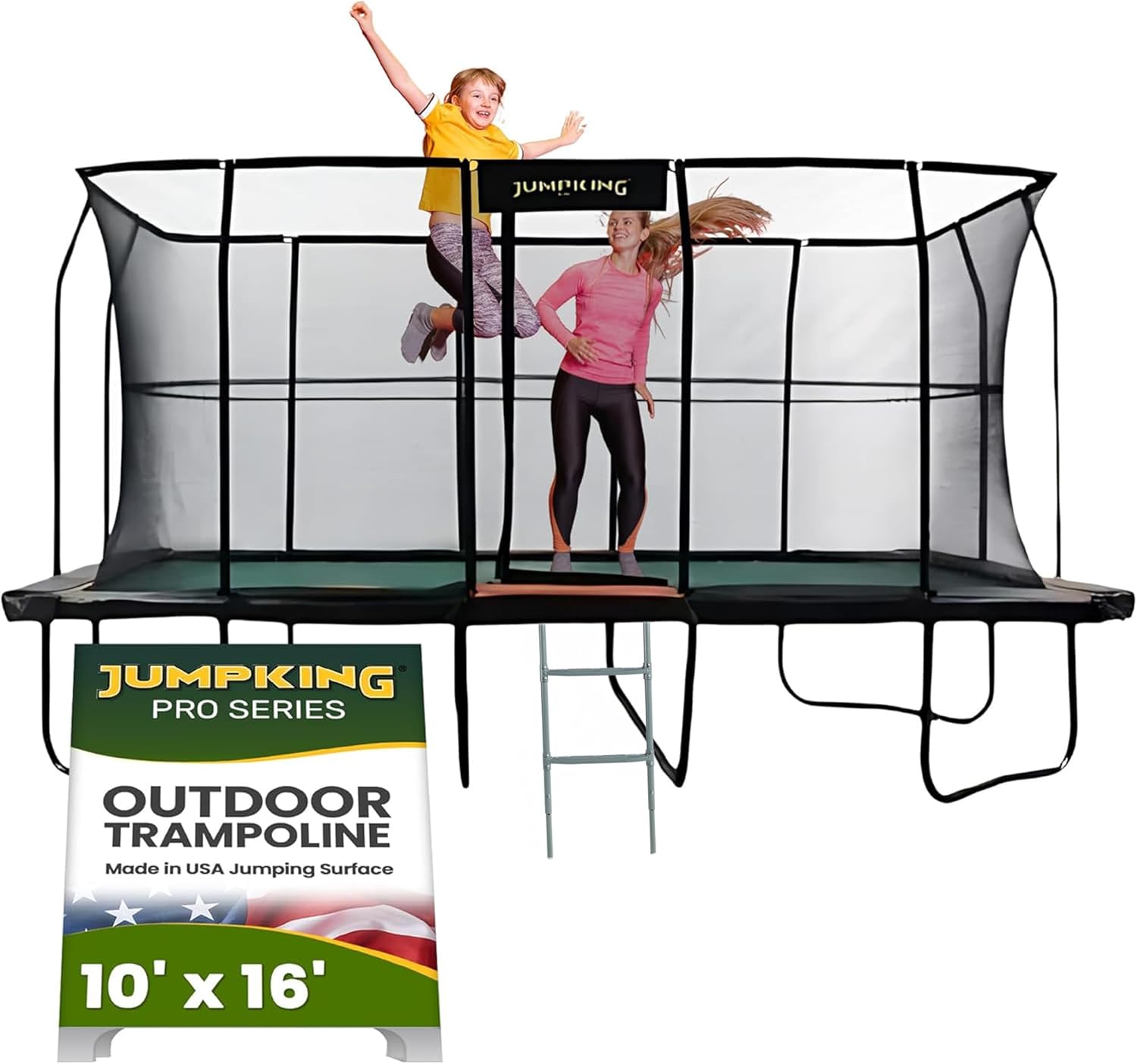
The Verdict: If you want the rectangular shape for gymnastics practice but can’t afford the Galactic or ACON, JumpKing is the reliable budget choice. It offers the linear bounce benefit without the $2,000+ price tag.
The Competition: What We Rejected
We analyzed more than just the top 5. Here are other popular models and why they didn’t make the cut:
- Generic “Mega” Brands (Amazon Alphabet Soup): Many listing claim “18ft” but measure the frame curvature improperly. Support is non-existent.
- Springfree (Largest Oval): An incredible trampoline, but their largest size (13×13) is significantly smaller than the 16-18ft giants listed here, offering less tumbling runway.
- Propel Trampolines: Good budget options, but their weight limits (often 250lbs) are too low for the massive 16ft+ sizes where multiple kids are likely to jump.
The Ultimate [2026] Buying Guide for 18ft & Rectangular Trampolines
Preface: The Engineering of Giants
Stepping up to an 18ft or large rectangular trampoline is not merely buying a bigger toy; it is an architectural commitment. At this scale, the physics of tension, structural load, and wind resistance change dramatically compared to standard 10ft or 12ft models. A standard department store trampoline weighs perhaps 100 lbs; the beasts in this guide weigh between 300 and 600 lbs. They are semi-permanent structures that require precise leveling, professional-grade anchoring, and a deep understanding of metallurgy to ensure they don’t fold under the immense dynamic torque generated by a 200lb adult performing a double backflip. This guide is the definitive technical resource for parents, coaches, and enthusiasts ready to go big.
Chapter 1: The Geometry of Bounce (Shape Physics)
When you spend over $1,000, “bounciness” isn’t a vague feeling; it’s a measurable outcome of spring mechanics and mat geometry. The shape you choose dictates the entire user experience.
1.1. Rectangular: The “Sweet Spot” Phenomenon
Rectangular trampolines (like the Galactic Xtreme or ACON Air) are the industry standard for gymnastics for one specific reason: Independent Spring Engagement.
On a rectangular frame, when you jump near the end, only the springs in that immediate vicinity engage. This means the tension—and therefore the rebound height—remains consistent regardless of where you land on the mat. The “Sweet Spot” is effectively the entire length of the jumping surface. This predictability is mandatory for tumbling passes; a gymnast needs to know that their third back handspring will have the same lift as their first, even if they have drifted 10 feet down the mat.
1.2. Round: The Centripetal Draw
Round trampolines (like the Zupapa 16ft) function differently. Because all springs are equidistant from the center, the entire system acts as a single cohesive unit.
The Physics: When you land off-center, the springs on the far side pull harder than the springs near you, naturally directing your rebound back toward the geometric center of the mat.
Pros: This is a massive safety feature for recreational jumpers and parties, as it actively prevents users from bouncing into the springs or off the edge.
Cons: It ruins gymnastic training. Attempting a straight line of flips is impossible as the mat constantly pushes you sideways.
1.3. Oval: The Hybrid Compromise
Oval trampolines (like the Skywalker 17×15) attempt to bridge the gap. They have two focal points for bounce (similar to an ellipse). They offer a better jumping line than a round trampoline but lack the pure independence of a rectangle. Their primary advantage is spatial: they fit into long, narrow urban yards where a massive square or circle would block pathways.
Chapter 2: Structural Integrity & Metallurgy
At 18 feet wide, the leverage forces on the frame are enormous. A cheap frame will “taco” (fold in half) during a storm or heavy use.
2.1. Steel Gauge & Diameter
Steel thickness is measured in Gauge (lower is thicker).
Department Store Grade: 16-gauge (1.5mm). Fine for 10ft models, dangerous for 16ft+.
Consumer Heavy-Duty: 13-gauge (2.2mm). The minimum acceptable standard for big trampolines.
Commercial Grade: 10-11 gauge (3.0mm). Found on the Galactic Xtreme. This steel is thick enough that you could hit it with a sledgehammer and it wouldn’t dent. It provides a rigid base that doesn’t flex, ensuring all energy goes into the bounce rather than being absorbed by a wobbly frame.
2.2. Galvanization Process
Rust is the enemy. There are two main protection methods:
Spray/Paint Galvanization: Cheap. The coating chips off, and rust starts within 2 years.
Hot-Dip Galvanization: The steel tubing is dipped into molten zinc, coating both the inside and outside of the tube. This is critical because condensation builds up inside the legs. Without internal galvanization, a trampoline can rust from the inside out and collapse without warning.
2.3. Weld Points vs. T-Sockets
Avoid welded leg connections. The heat from welding weakens the surrounding steel (heat-affected zone), creating a point of failure. Look for T-Socket joints or “uni-bodied” interlocking frames where the leg pieces slot together without relying on a weld to hold the vertical load.
Chapter 3: Spring Dynamics
The “Bounce” is determined by Hooke’s Law (F = -kx). In trampoline terms, this translates to spring length and count.
- Short Springs (5.5″ – 7″): Create a sharp, jarring stop. High impact on knees and back. Common on cheap models.
- Long Springs (8.5″ – 10″): Found on premium 18ft models. They have a longer extension cycle, creating a slower, deeper, “floating” sensation. This lower G-force acceleration is safer for joints and allows time for performing complex aerial maneuvers.
- Spring Count Myth: More isn’t always better. If you have too many stiff springs, a light child won’t weigh enough to extend them, and bouncing will feel like jumping on concrete. Premium brands tune the spring count (usually 120-160 for 18ft) to balance resistance.
Chapter 4: The Mat (Jumping Surface)
Most mats are made of Polypropylene (PP), but the weave matters.
Permatron: The trademarked gold standard. It has high tensile strength, UV resistance, and—crucially—specific airflow properties.
Airflow Physics: As you fall, the mat pushes a column of air downwards. If the mat weave is too tight, air resistance (drag) slows the mat down, killing the bounce. High-performance mats (like ACON’s) have a slightly more open weave to reduce drag, allowing faster acceleration.
Stitching: Look for 8-10 rows of UV-resistant stitching on the V-rings (where springs attach). This is the most common failure point. Once a single V-ring rips off, it creates a domino effect, unzipping the entire mat.
Chapter 5: Safety Enclosure Systems
Falls account for over 60% of trampoline injuries. The net is your goalie.
5.1. Internal vs. External Nets
- External Nets: The net sits outside the springs. This maximizes play space but leaves the springs accessible. Even with padding, a foot can slip between springs (the “pinch zone”).
- Internal Nets: The net attaches to the edge of the mat, isolating the springs completely. This is much safer, though it visually shrinks the play area. Skywalker’s “No-Gap” buttonhole system is the best implementation of this, sewing the net to the mat.
5.2. Pole Geometry
Straight poles are a hazard; kids hitting the net can collide with the steel pole. Look for Curved or Angled Poles (Zupapa) that bow outward, creating a safety gap between the net and the steel. High-quality foam sleeves (vinyl-coated) are also mandatory to absorb impact.
Chapter 6: Site Preparation & Installation
You cannot just drop an 18ft beast on a hill.
Slope Tolerance: The ground must be level within 1-2 degrees. If it tilts, the jumper will drift downhill on every bounce, impacting the lower side of the frame repeatedly, which causes stress fractures.
Overhead Clearance: You need 24 feet of vertical clearance. No tree branches, power lines, or roof overhangs.
Lateral Clearance: Keep 6 feet of clearance around the perimeter. If a jumper clears the net (rare but possible), they need soft grass to land on, not a brick wall or AC unit.
Before assembly, lay down commercial-grade landscape fabric and mulch/gravel under the trampoline area. Once the 400lb structure is built, you will NOT be able to mow the grass underneath it easily. Moving an 18ft trampoline to mow requires 3-4 adults.
Chapter 7: Wind Mitigation (The Sail Effect)
An 18ft trampoline has a surface area of over 250 square feet. In a 40mph wind, it generates hundreds of pounds of lift. We have seen countless videos of 18ft trampolines flying over fences and crushing cars.
The Anchoring Protocol:
Do not use the cheap U-shaped stakes that look like tent pegs; they pull out of wet soil instantly.
You need Auger Anchors (Corkscrews). These screw 12-18 inches deep into the subsoil. You must use heavy-duty ratchet straps (not thin nylon cord) to connect the frame to the eyelet of the anchor. Use a minimum of 4 anchors (one per corner for rectangles, or every 3rd leg for rounds). In high-wind areas (Hurricane zones), consider 8 anchors.
Chapter 8: Maintenance & Winterization
- Spring Rotation: Every year, swap the springs from the high-use center areas with the springs from the corners/sides. This ensures even fatigue and extends the lifespan of the set.
- Snow Load: Heavy wet snow can weigh thousands of pounds. It will stretch the springs permanently (ruining the bounce) or buckle the frame. If you live in a snowy area, you must either disassemble the mat or go out during the storm with a broom to clear the load.
- UV Protectant: Spray the safety net and spring pads with “303 Aerospace Protectant” or similar marine-grade UV blockers twice a year. This prevents the plastic from becoming brittle and turning to dust.
Chapter 9: The Verdict
For the aspiring Olympian or cheerleader, the Happy Trampoline Galactic Xtreme is the only choice. Its rectangular physics mimic gym conditions perfectly. For the family who just wants the biggest, safest playpen for neighborhood parties, the Zupapa 16ft Round offers unbeatable value per square foot and is readily available. Whatever you choose, budget an extra $50 for heavy-duty wind anchors—they are the cheapest insurance you will ever buy.